How the U.S. Supreme Court stole our democracy
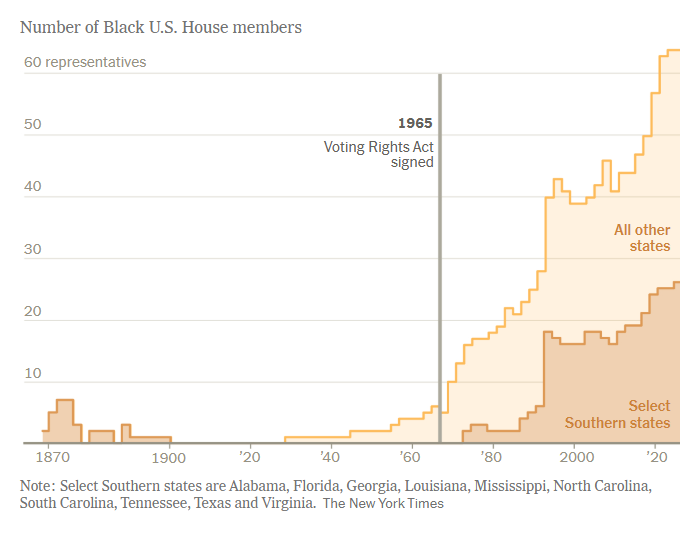
Two weeks ago, the U.S. Supreme Court issued their opinion in Louisiana v. Callais, gutting one of the few remaining mechanisms to protect the right to vote and enforce the promises of the Fourteenth and Fifteenth Amendments. The ruling is undeniably seismic, but it is also one component in a decades-long project designed to make our elections less free, less fair, and less representative.
This is how the U.S. Supreme Court stole our democracy.
1976: Buckley v. Valeo
Ruling: Governmental restriction of independent expenditures in campaigns, the limitation on expenditures by candidates from their own personal or family resources, and the limitation on total campaign expenditures violate the First Amendment.
Impact: Allowed the extremely wealthy to spend unlimited money in support of or opposition to a candidate and paved the way for the future Citizens United ruling (by equating money with speech).
1980: City of Mobile v. Bolden
Ruling: The Fifteenth Amendment did not entail "the right to have Negro candidates elected”; only purposefully discriminatory denials of the freedom to vote on the basis of race demanded constitutional remedies
Impact: To prove a voting-related law was unconstitutional, plaintiffs have to prove that officials had intentionally discriminated against minorities, not just that a facially neutral policy had had a discriminatory effect.
1982: Nixon v. Fitzgerald
Ruling: The President "is entitled to absolute immunity from damages liability predicated on his official acts."
Impact: Provided the president with "absolute immunity” to civil suits arising from official conduct, and laid the groundwork for Trump v. United States.
1985: FEC v. National Conservative PAC
Ruling: Governmental restriction of expenditures by political action committees (PACs) violate the First Amendment.
Impact: Allowed independent political action committees to spend an unlimited amount to support a presidential candidate, setting up the invention of modern Super PACs.
2004: Vieth v. Jubelirer
Ruling: Partisan gerrymandering claims are nonjusticiable until there is a discernible and manageable standard for "adjudicating political gerrymandering claims."
Impact: Made it harder to bring claims of partisan gerrymandering in courts
2005: Chief Justice John Roberts confirmed to the Supreme Court
Roberts was confirmed by a Senate vote of 78–22.
2006: Purcell v. Gonzalez
Ruling: “Court orders affecting elections…can themselves result in voter confusion and consequent incentive to remain away from the polls. As an election draws closer, that risk will increase.”
Impact: Gave rise to the “Purcell Principle,” which is the idea that the courts should not change election rules too close to an election. However, in practice, the Supreme Court has invoked the principle only when politically convenient for the GOP (e.g., the court said 11 months was too close to an election to enact un-gerrymandered maps in Texas (Abbott v. LULAC) but allowed Louisiana to enact gerrymandered maps in the middle of an election, voiding casted votes (Louisiana v. Callais)).
2008: Crawford v. Marion County Election Board
Ruling: Voter ID laws are constitutional, reasoning that any burdens that arise are offset by the state's interest in reducing fraud.
Impact: Allowed the proliferation of voter ID laws that disenfranchise low income, minority, elderly, and disabled voters, despite a lack of evidence of widespread voter fraud. Also rejected the long held idea that the costs associated with obtaining a specific form of ID (e.g., lost wages, transportation, fees for obtaining documents like birth certificate, etc.) amounted to a poll tax.
2010: Republican operatives launch REDMAP
Using new mapping software, GOP operatives assisted swing state Republican lawmakers in creating extreme gerrymanders to ensure their party gained and retained political control regardless of a lack of popular support. “He who controls redistricting can control Congress,” Karl Rove wrote in a WSJ column that year.
2010: Citizens United v. FEC
Ruling: Limiting independent expenditures on political campaigns by groups such as corporations, labor unions, or other collective entities violates the First Amendment because limitations constitute a prior restraint on speech.
Impact: Gave rise to Super PACs and unlimited outside spending in elections. Whereas outside spending in the 2004 and 2008 presidential cycles hovered around $500 million, by 2016 it had risen to $1.6 billion and in 2024 reached a record $4.46 billion.
2013: Shelby County v. Holder
Ruling: Section 4(b) of the Voting Rights Act, containing the formula for federal preclearance, is unconstitutional.
Impact: By effectively abolishing federal preclearance, the court removed guardrails preventing states and localities from engaging in voter suppression. Numerous subsequent studies found that the ruling led to an increase in discriminatory voting practices, including the closure of polling places in African American communities, cuts to early voting, purges of voter rolls, and imposition of strict voter ID laws.
Morris and Miller (2026): “...once they were removed from the preclearance list, counties enacted policies whose cumulative effect was to disproportionately burden minority voters.”
2014: McCutcheon v. FEC
Ruling: Limits on contributions an individual can make over a two-year period to all national party and federal candidate committees are unconstitutional.
Impact: Again created a new pathway for the wealthy to wield an outsized influence on politics and politicians.
2018: Abbott v. Perez
Ruling: State legislatures are entitled to a presumption of legislative good faith in redistricting cases; the challengers have the burden of proof when alleging that a state law was enacted with discriminatory intent
Impact: Made it harder to challenge gerrymandered maps by shifting the burden of proof in direct contradiction to Section 2 of the Voting Rights Act (which focused on the result of a voting-related law, not the intent).
2018: Husted v. Randolph Institute
Ruling: Purging infrequent voters from voter rolls is constitutional if combined with additional requirements (in this case, a mailed confirmation notice)
Impact: 22 states now have laws that initiate voter removal solely based on inactivity, creating a “use-it-or-lose-it” system for a foundational constitutional right.
2019: Rucho v. Common Cause
Ruling: Partisan gerrymandering claims are never justiciable because they present a political question beyond the reach of the federal courts
Impact: Eliminated federal lawsuits against partisan gerrymandering, making it nearly impossible to challenge maps in federal court
2021: Brnovich v. Democratic National Committee
Ruling: Laws invalidating ballots cast out of precinct and banning ballot collection do not violate the Voting Rights Act
Impact: More than 20 states now have laws limiting who can return a ballot for a voter (e.g., only the voter, only a spouse, only an immediate family member, etc.). Also limited the Voting Rights Act’s general provision barring discrimination against minorities in state and local election laws through the introduction of new means to review Section 2 challenges.
2022: FEC v. Ted Cruz for Senate
Ruling: Limits on the amount of money that candidates could be paid on personal loans to their campaign are unconstitutional violations of the First Amendment.
Impact: Allowed the wealthy to loan their campaigns unlimited funds and use post-election fundraising to pay themselves back in full (the previous limit was $250,000).
2024: Alexander v. South Carolina State Conference of the NAACP
Ruling: To prove unconstitutional racial gerrymandering, a plaintiff must show that race was the “predominant factor motivating the legislature’s decision to place a significant number of voters within or without a particular district.”
Impact: Made it more difficult to bring challenges to racial gerrymanders when partisanship and race correlate
2024: Trump v. United States
Ruling: The President has absolute immunity from prosecution for actions taken pursuant to his exclusive constitutional powers and at least presumptive immunity from prosecution for all his official acts
Impact: Precluded criminal prosecution of President Trump for crimes committed during his first term, allowed him to run for a second term, and gave him carte blanche to commit countless crimes.
2026: Louisiana v. Callais
Ruling: Intentionally drawing districts predominantly on the basis of race (even if the result better represents the people), is unconstitutional under the Fourteenth Amendment
Impact: Further limits when maps can be challenged under the Voting Rights Act by requiring that plaintiffs show that minority voters have less opportunity than others due to intentional discrimination rather than politics or other race-neutral factors. In other words, as long as a state says that redistricting was done based on politics and not race, majority-minority districts can be eliminated.
Where things stand now
Louisiana
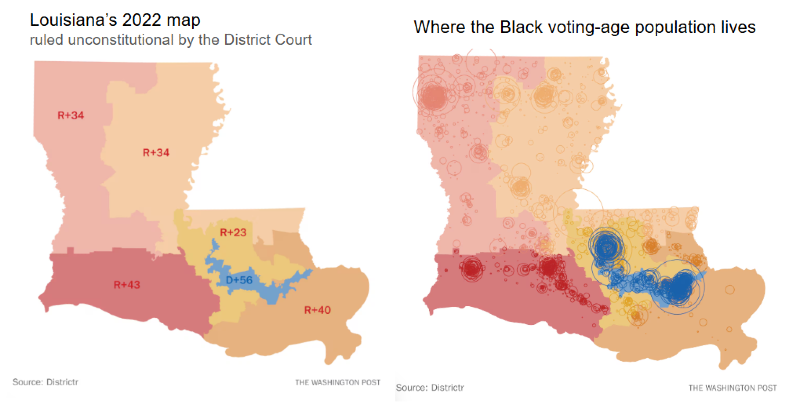
- Immediately after the Callais ruling was released, Louisiana Gov. Jeff Landry declared a state of emergency and suspended the ongoing U.S. House primary elections in order to first redraw the majority-Black 6th district.
- The plaintiffs, which include lead plaintiff Bert Callais, an apparent participant in the Jan. 6 insurrection, filed a request that the U.S. Supreme Court expedite finalizing its ruling (normally there is a 32-day waiting period) so the state could begin drawing a new map. The conservative justices, unsurprisingly, agreed. Justice Jackson dissented: “The Court’s decision to buck our usual practice…is tantamount to an approval of Louisiana’s rush to pause the ongoing election in order to pass a new map.”
- Louisiana lawmakers met last Friday to begin revising the state’s congressional map, likely aiming to craft a map similar to the 2022 version deemed unconstitutional. If only the 6th District is altered to more reliably elect a white (presumably Republican) lawmaker, the state will have 1 out of 6 districts in which a Black majority can elect a representative of their choice. 1 out of 3 Louisiana residents is Black.
Tennessee
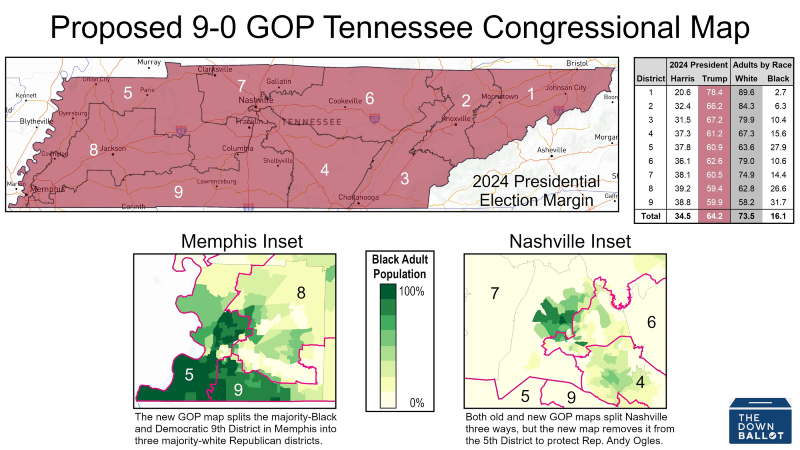
- Tennessee lawmakers repealed a 1972 law that prohibited mid-decade redistricting last Thursday.
- After carving up Nashville to eliminate a Democratic seat in 2022, the state had only one reliably Democratic seat left: the 9th District of Memphis. It is also the state’s only majority Black district. Last week, Republican lawmakers passed a new map that likewise eliminates the 9th District, creating a 9-0 Republican map.
- While in the midst of disenfranchising Black and Democratic voters, Tennessee lawmakers also eliminated the statutory requirement to notify voters of their new polling places in the new congressional districts.
Alabama
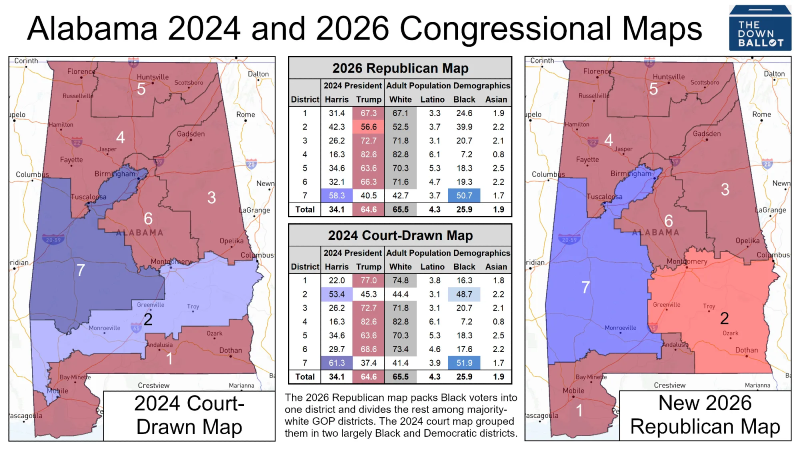
- Alabama lawmakers met during a tornado watch in a flooded building to pass legislation allowing for new U.S. House primaries if courts allow the state to use different congressional districts in this year's elections. While Gov. Kay Ivey (R) mentioned reverting to a 6-1 Republican map similar to the 2023 version that the courts (including the U.S. Supreme Court) held was an unconstitutional racial gerrymander, Alabama’s lieutenant governor called for the legislature to gerrymander all Democratic seats out of existence.
- The U.S. Supreme Court granted Alabama’s request to vacate the earlier rulings that prevented Alabama from using its discriminatory map and sent the case back to the District Court for the Northern District of Alabama “for further consideration in light of Louisiana v. Callais.” Justices Sotomayor, Kagan, and Jackson dissented, writing that the District Court’s previous “constitutional finding of intentional discrimination is independent of, and unaffected by, any of the legal issues discussed in Callais.”
Mississippi
- Mississippi lawmakers plan to convene a special session to discuss redistricting in the Old Capitol building, where Mississippi lawmakers once implemented Jim Crow and voted to secede from the Union over slavery. However, the special session may be canceled after the 5th Circuit ruled that the racially-discriminatory state supreme court map they were going to redraw does not need to be changed in light of Callais.
- Mississippi State Auditor Shad White advocated for repurposing the special session to eliminate the state’s only majority-Black congressional district, held by Rep. Bennie Thompson (D).
Florida
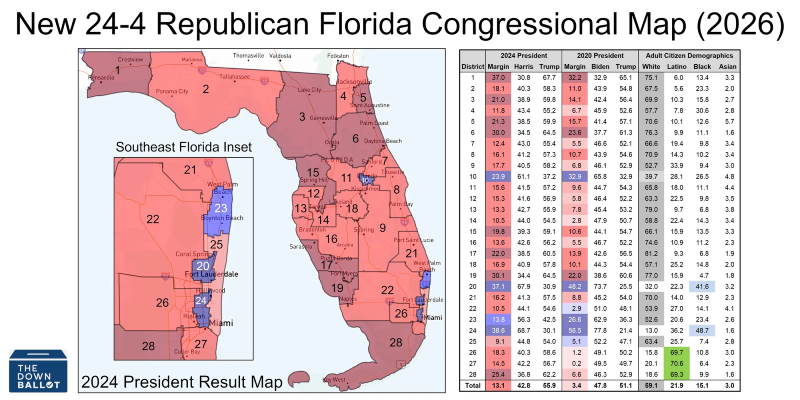
- Five days after the Supreme Court released Callais, Florida Gov. Ron DeSantis (R) signed a new 24-4 Republican congressional gerrymander into law. The map targets the majority-Latino District 9 seat currently held by Puerto Rican Rep. Darren Soto (D), turning it into a R +17 district.
South Carolina
- House lawmakers in South Carolina adopted a resolution to pass a new congressional gerrymander after the current session ends on May 14, planning to eliminate the largely Black and Democratic 6th District. However, Senate lawmakers could not muster the necessary two-thirds support to approve the measure.
Missouri
- The Missouri Supreme Court upheld the gerrymandered congressional map created by lawmakers last year, which eliminated the Democratic 5th district encompassing Kansas City. Voters had submitted 300,000 signatures to put a referendum to repeal the map on the 2026 ballot, but Secretary of State Denny Hoskins (R) stalled for months to allow the courts to independently approve the map.
Virginia
- Virginia voters approved a constitutional amendment allowing mid-decade congressional redistricting last month with 51.7% in favor. The new maps could have potentially shifted four of the state’s Republican-held seats to a Democratic candidate in an attempt to negate the GOP’s nationwide gerrymandering push.
- Virginia’s supreme court struck down the voter-approved plan in a 4-3 ruling, reasoning that Virginia Democrats did not start the process early enough in the election cycle.
- Virginia Democratic leaders have appealed to the U.S. Supreme Court, seeking a stay of the state supreme court’s ruling. “By rejecting the plain text of the Virginia Constitution’s definition of the term ‘election’ to adopt its own contrary meaning,” they argue, “the Supreme Court of Virginia ‘transgressed the ordinary bounds of judicial review such that it arrogated to itself the power vested in the state legislature to regulate federal elections.’”