Don't look away: The U.S. is still bombing people, just not the ones you hear about

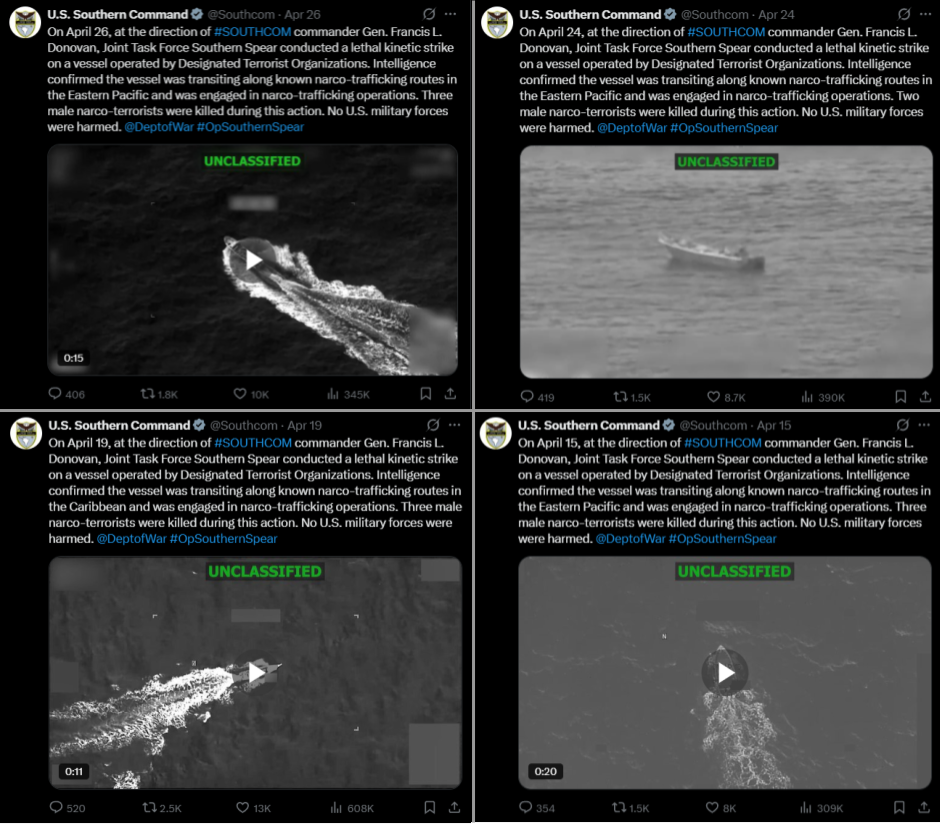
“I’m not going to start a war. I’m going to stop wars,” Donald Trump said in his 2024 election night victory speech. Yet, roughly a year and a half into his second term, Trump has ordered military strikes in at least seven countries and overseen the extrajudicial murder of nearly 200 people in the Caribbean and Pacific. Some of these operations are ongoing, overshadowed by Trump’s war of choice in Iran. This post will look at the lesser known wars the Trump administration has started in our name, lest we lose track in the constant stream of daily outrages.
Caribbean Sea and Pacific Ocean
Despite the diversion of U.S. equipment, weapons, and personnel to the Middle East, Trump’s war on alleged “narco-terrorists” in the waters around Central and South America has intensified. In the past month alone, the military has carried out six strikes on boats in the Pacific Ocean and two strikes on vessels in the Caribbean, killing a combined 22-23 people (one person survived, but there is no indication that they were rescued).
The increase in strikes reflects a surge of attack aircraft sent to U.S. bases in El Salvador and Puerto Rico in recent weeks, according to the New York Times:
In the past few weeks, the military has without public notice increased the number of secret fixed-wing attack aircraft and armed MQ-9 Reaper drones operating from bases in El Salvador and Puerto Rico, allowing the military to accelerate the strikes, the two people said, speaking on condition of anonymity to discussion [sic] operational matters. [...]
Before the increase in aircraft, a suspected drug boat might have had a 50 percent chance of evading the military, the military official said. Now that is down to about 25 percent, said the official, who declined to describe how the military determines which boats to sink and which to allow the Coast Guard to board and seize — as it has done for decades with drug traffickers.
As must be stressed every time: there is no evidence that the people killed in these strikes are drug traffickers, nor would they face the death penalty if they were. And there is mounting evidence that at least some were not engaged in any kind of criminal activity at all; they were just average fishermen trying to make a living for themselves and their families.
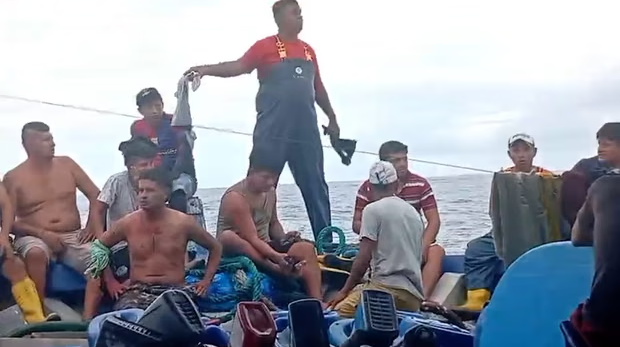
Last week, the Guardian tracked down survivors of one of the attacks (it is not clear which strike, as the U.S. military never acknowledged the incident) who described being bombed, kidnapped, and abandoned in El Salvador by American forces:
A group of Ecuadorian fishers have described how they were attacked in a double drone strike and then detained at gunpoint by soldiers on a US-flagged patrol vessel, in a rare first-hand account by victims of Donald Trump’s militarized campaign against alleged drug-trafficking boats off South America. [...]
The first drone strike hit the bow of the boat, and the second hit the antenna, knocking out all communications, he said. Debris from the explosion raked through the crew. One of the fishers, Erick Fabricio Coello Saltos, 27, said his hearing and his vision were both damaged in the blast. “When I heard an explosion, my eardrums ruptured terribly ... I was covered in blood from the shrapnel,” he told Radio Contacto.
The fishers claim drones continued to circle overhead after the blasts, leaving them fearing another strike. Mobile phone footage of the aftermath of the attack shows the terrified crew huddled at the stern of the ship, with an alarm sounding as one of them waves a white shirt. One man appears to be wiping blood from his nose.
Shortly afterwards, the crew say they were approached by a US patrol boat, and were ordered to board. Palacios says that when the crew were onboard the patrol vessel, their phones were confiscated and most photos and videos of the attacks wiped.
Once the men were on the patrol boat, the US personnel boarded the fishing boat and stole the crew’s food and the beer, Palacios said. When Palacios looked back at the Don Maca, it was already in flames. “We saw the ship burn,” he said.
The crew of the patrol boat spoke English to each other, and used a translator to address the Ecuadorians. “From the moment we arrived on the US patrol boat, they were pointing guns at us, shouting: ‘Get in, get in,’” said Palacios, 54. “They handcuffed us, put hoods over our heads and pushed us around. We were terrified they were going to kill us.”
According to the crew’s account, they were held for several hours by the US vessel before being transferred to a Salvadorian patrol boat and, after several more days at sea, eventually to El Salvador, where they were taken to a military base and questioned. Later they were handed over to immigration authorities and taken to a UN shelter.
Drop Site News also interviewed a different group of Ecuadorian fishermen who similarly allege that the U.S. military bombed, kidnapped, and abandoned them in El Salvador weeks earlier.
Ecuador
Did the U.S. just bomb Ecuador? That’s the impression Secretary of Defense Pete Hegseth seemed eager to create last month when he posted “we are bombing Narco Terrorists on land as well” alongside video of airstrikes on a building in the jungle. “At the request of Ecuador, the Department of War executed targeted action to advance our shared objective of dismantling narco-terrorist networks,” Pentagon spokesman Sean Parnell wrote in the quoted post.
So far, no reports confirmed that U.S. troops directly participated in the airstrikes. Anonymous sources told the New York Times that the American military only provided intelligence to Ecuadorian forces, guiding them to their target. One anonymous official said the U.S. also provided a helicopter. As Just Security explained, Ecuador’s government may have its own reasons to obscure U.S. involvement: voters there recently rejected foreign military bases in a national referendum. Alternatively, Hegseth may simply be inflating America’s role in an attempt to bolster his “warfighter” ethos.
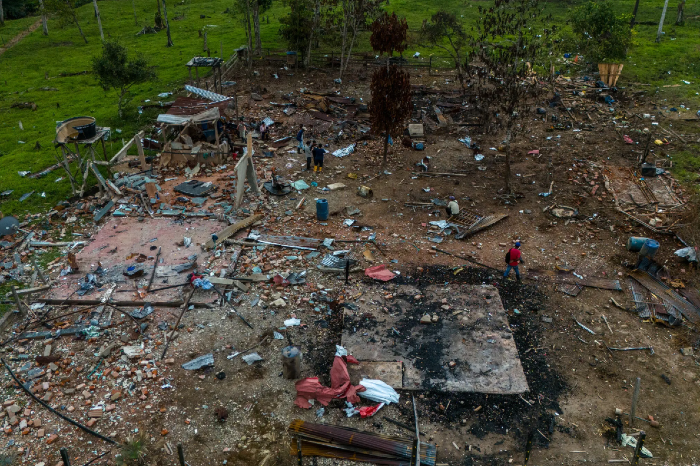
Regardless, even if the Department of Defense provided only the most minor of assistance — intelligence and logistics — it appears that the United States may have directed Ecuadorian forces to bomb not a drug trafficking center, but a civilian dairy farm.
Workers on the farm told The Times that Ecuadorean soldiers arrived by helicopter on March 3, doused several shelters and sheds with gasoline and ignited them after interrogating workers and beating four of them with the butts of their guns. Three of the workers, who requested anonymity for fear of retaliation by the government, said the soldiers later choked and subjected them to electrical shocks before letting them go.
Village residents said Ecuadorean helicopters returned to the farm three days later, on March 6, and appeared to drop explosives on the farm’s smoldering remains. It was at that point, they said, that Ecuadorean soldiers recorded the footage that U.S. and Ecuadorean officials said captured the bombing of a traffickers’ compound. [...]
The dairy farm’s owner, Miguel, said he bought the 350-acre farm about six years ago for $9,000, growing it to more than 50 cows used for milk and meat. [...] As Miguel stood in the rubble, he denied that his farm was used as a training camp, and said he was baffled by the military’s decision to bomb the property. He fought back tears as he explained what was there before: two wooden shelters, an outpost to make cheese, sheds for his equipment. The horse paddock was spared, but the chicken coop was gone. [...]
The Alliance for Human Rights, a coalition of groups in Ecuador, filed a 13-page complaint with the Ecuadorean authorities and the United Nations, claiming that the military’s actions were attacks on a civilian population. “There isn’t a single public official who has come to verify what happened,” said María Espinosa, a human rights lawyer.
Somalia
U.S. military operations in Somalia are not new, but they have expanded significantly under Trump. Airstrikes targeting ISIS-linked groups and an al-Qaeda affiliate called Al-Shabaab are now occurring at a pace that exceeds previous administrations, with 2026 on track to set a new record. In the first four months of the year alone, strikes have averaged one every two days.
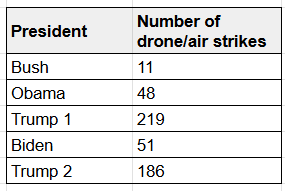
Official U.S. Africa Command (AFRICOM) press releases rarely address how many targets were killed, let alone if any civilians were killed. Consequently, it is impossible to gauge the efficacy and accuracy of the strikes.
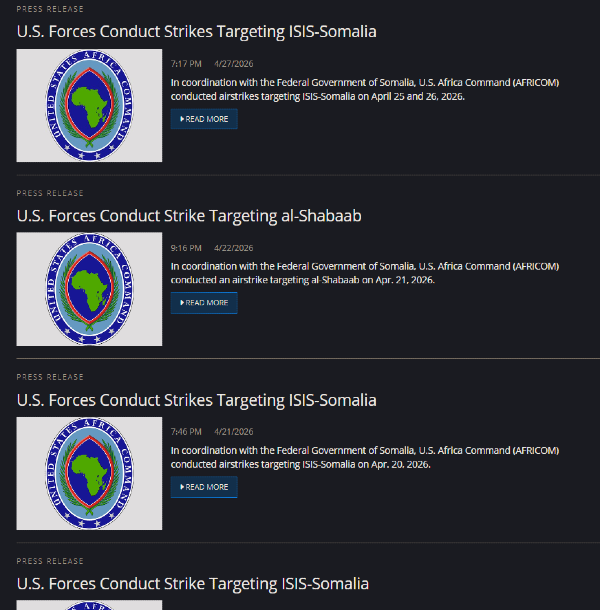
For example, the following is a relatively detailed U.S. press release about a Sept. 13, 2025 airstrike in Somalia:
In coordination with the Federal Government of Somalia, U.S. Africa Command (AFRICOM) conducted airstrikes targeting an al Shabaab weapons dealer on Sept. 13, 2025.
The airstrikes occurred in the vicinity of Badhan, Somalia.
AFRICOM, alongside the Federal Government of Somalia and Somali Armed Forces, continues to take action to degrade al Shabaab’s ability to threaten the U.S. homeland, our forces, and our citizens abroad.
Specific details about units and assets will not be released to ensure continued operations security.
Local Somali media reported that the man who was killed was a “prominent clan elder” (more information) who facilitated mediation and conflict resolution in the region:
Security officials in Somalia’s Puntland region have strongly condemned an airstrike that killed a prominent clan elder on Saturday in the Jiicanyo area, part of Ceel-buh district in the eastern Sanaag region. According to Aden Ahmed Ali, the Police Commander for Sanaag Region, a military aircraft fired three missiles at a vehicle carrying Elder Omar Abdullahi Abdi Ibrahim on Saturday afternoon.
“Yesterday afternoon, residents of Urur and Jiicanyo alerted police about an aerial bombardment along the road between Ceel-buh and Badhan. When we arrived at the site, we found the elder’s vehicle and his body completely burned,” Commander Ali told reporters. “Further investigation confirmed that the victim, who was alone in a RAAF-type vehicle, was targeted by three missiles launched from a military aircraft.” [...]
Security sources noted that the elder had recently been in Bosaso, Puntland’s commercial capital, where he participated in a series of consultations between government officials and community leaders from the Sanaag and Haylaan regions.
Was Omar Abdullahi Abdi Ibrahim an Al-Shabaab weapons dealer, or did the U.S. unilaterally murder a keystone of Somali society without evidence of him being a combatant? We will likely never know because the government only has to cast the strike as part of a “counterterrorism” operation to avoid all questions. But when the Commander in Chief has made reams of racist and eugenicist remarks maligning Somalia and the Somali people, should we not question the purpose of a 1,000+% increase in airstrikes when Trump took power last year?
Yemen
In February 2025, the Trump administration rolled back constraints on military commanders, removing the requirement that high-ranking officers obtain White House approval to fire on “official terrorist” designees. Roughly two weeks later, the Department of Defense used the new rule to embark on an eight week bombing campaign of the Houthis in Yemen.
The operation, developed by Gen. Michael Kurilla, originally consisted of an 8-10 month bombing campaign to take out Houthi air defenses, followed by “targeted assassinations modeled on Israel’s recent operation against Hezbollah.” Trump backed the plan after Saudi officials provided a target list of 12 Houthi senior leaders whose deaths, they said, would cripple the movement.
Trump reportedly cut the mission short, however, due to mounting American losses — the Houthis shot down seven American MQ-9 drones ($30 million a piece) and two F/A-18 Super Hornet fighter jets ($67 million each) fell from an aircraft carrier into the Red Sea — and Secretary of Defense Pete Hegseth’s escalating “Signalgate” controversy (wherein Hegseth and other top Trump appointees discussed sensitive and classified intelligence about the military operations in Yemen).
All told, the U.S. bombing of Yemen killed at least 224 civilians, nearly doubling the civilian casualty toll in Yemen by U.S. actions since 2002, according to the non-profit Airwars.
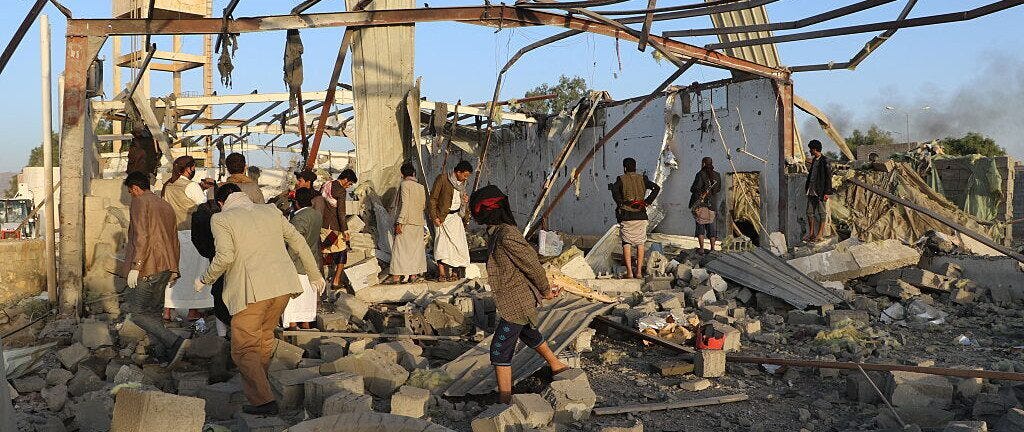
One of the deadliest incidents occurred on April 28, 2025, when an airstrike hit an immigration detention center in Saada, killing at least 68 detained African migrants and wounding 47 others. The detention center reportedly used to be used as military barracks years ago, suggesting that U.S. forces relied on outdated intelligence to target the airstrikes (and foreshadowing the deadly U.S. strike on the girl’s school in Iran in 2026).
Nigeria
On December 25, 2025, the U.S. military conducted airstrikes against Islamic State-affiliates in northwestern Nigeria. Very little about the operation has been made public; reports indicate that while some militants were killed, other strikes may have hit civilian areas, including homes and farmland.
Just as murky is the reasoning for the strikes. President Trump declared that the Christmas Day bombing campaign was aimed at stopping “Christian genocide” by “radical Islamists.” However, experts and residents say armed groups target civilians regardless of faith:
“They don’t ask you whether you are a Muslim or a Christian,” 32-year-old Abdulmalik Saidu said of the gunmen regularly stalking his northwestern state, Zamfara. “All they want is just money from you. (Even) if you have money, sometimes they will kill you.”
Saidu, a Muslim, said his brother was shot dead during a kidnapping operation along a major highway, and the family never recovered his body, for fear of attacks. In Kaduna, an imam told AP that he’s lost a grandson, cousin and brother, and his family has been displaced twice due to violence. Other religious leaders say mosques have been destroyed, people have fled, and desperate Muslims — like their Christian neighbors — have been forced to sell goods and belongings for ransom.
“The kind of pain we’ve gone through for the past years — this issue affects both faiths,” said the imam, Idris Ishaq.
According to the New York Times, Christian activists have spent years trying to convince the American government that Nigeria was failing to address the persecution of Christians. After failing to persuade President Joe Biden’s administration to take direct action, they found a more receptive audience in Trump’s Christian nationalist circle:
Armed with gruesome anecdotes and shocking but in some cases unreliable data on the number of Nigerian Christians killed for their faith, two dozen activists from groups dedicated to exposing Christian persecution around the world, such as the international organization Aid to the Church in Need, pursued various Trump officials.
[...]anti-persecution groups secured the meeting with Trump officials near the White House just as Republicans were gathering for the annual Conservative Political Action Conference. Sitting at the grand wooden table, they outlined their concerns to Sebastian Gorka, the National Security Council’s senior director for counterterrorism, who has falsely argued that violence is a fundamental part of Islam.
Sean Nelson [of Alliance Defending Freedom], another attendee, spoke at a “Christian Persecution Summit” at CPAC the next day. He argued that putting Nigeria back on the Country of Particular Concern list would pressure the nation into taking action to protect Christians. “They value our economic relationship, they value the security assistance that we provide,” Mr. Nelson said of Nigerian officials.
The next day, on Oct. 31, Mr. Trump took to Truth Social to announce that he had officially put Nigeria back on the list, and then a short while later he posted that he had ordered the Pentagon to begin planning potential military action. “If we attack, it will be fast, vicious, and sweet,” he wrote.