Trump's Justice Department seeks veto power over state voter rolls
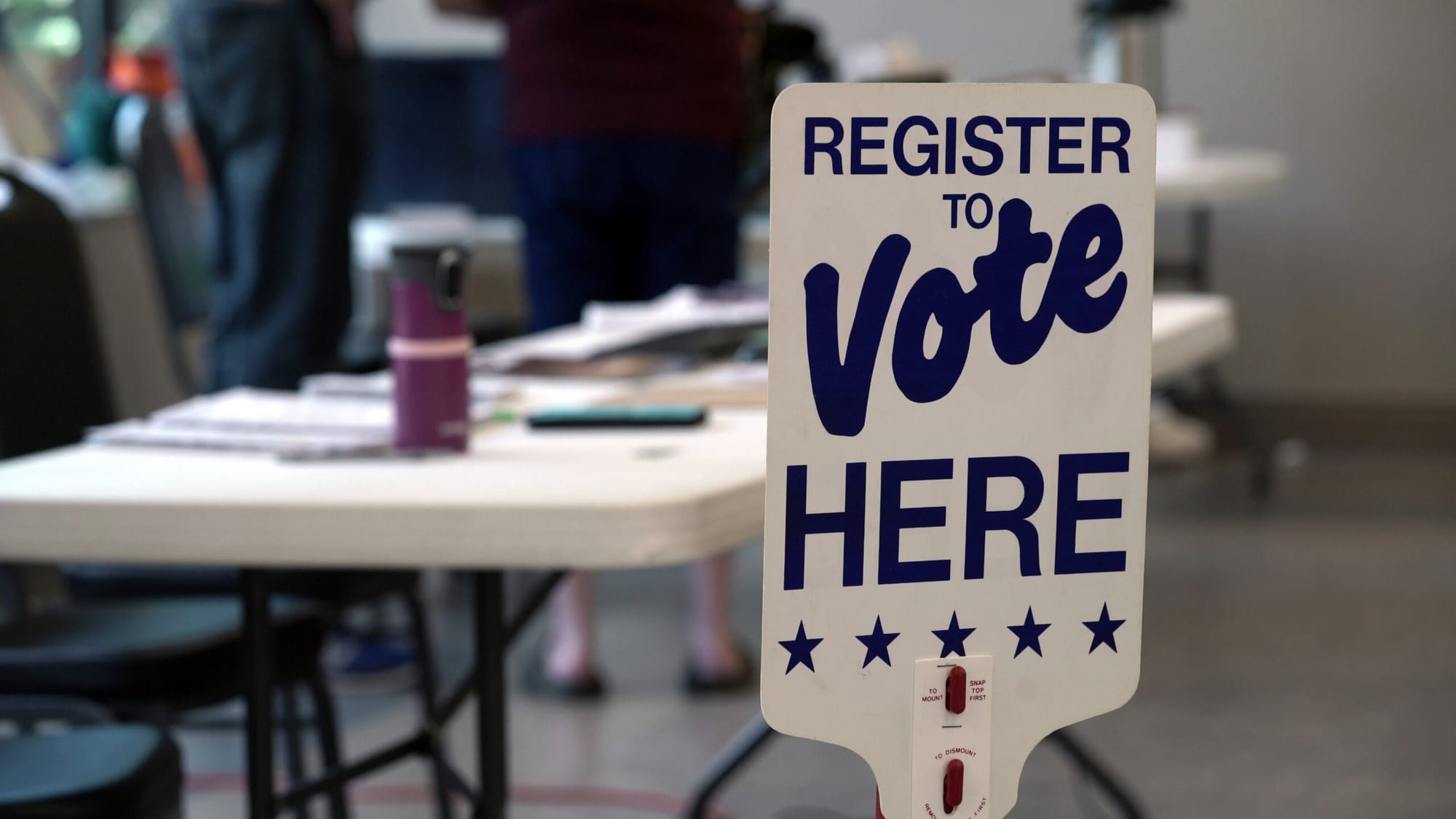
The Department of Justice (DOJ) has been demanding that every state share its voter registration lists — including highly sensitive data like driver’s license number, birthdate, and partial social security number — with the federal government.
To date, the DOJ says it has reached formal agreements with 11 states to access voter information: Alabama, Mississippi, Missouri, Montana, Nebraska, South Carolina, South Dakota, Texas, Tennessee, Utah, and Virginia. Four additional states — Arkansas, Indiana, Kansas, and Wyoming — have voluntarily turned over voter information without signing any agreement.
At least 21 states and Washington, D.C., have refused to comply, resulting in the DOJ filing lawsuits to obtain unredacted copies of their voter rolls: California, Colorado, Delaware, Georgia, Hawai’i, Illinois, Maine, Maryland, Massachusetts, Michigan, Minnesota, Nevada, New Hampshire, New Mexico, New York, Oregon, Pennsylvania, Rhode Island, Vermont, Washington, Washington, D.C., and Wisconsin.
The states’ objections center on voter privacy and constitutional authority, as Washington Secretary of State Steve Hobbs articulated in a letter rejecting the DOJ’s request:
Washington law requires that “current lists of registered voters…must be made available for public inspection and copying[.]” This disclosure, however, is limited to select data fields, including the voter’s name, address, political jurisdiction, gender, year of birth, voting record, date of registration, and registration number. Aside from these enumerated fields, “no other information from voter registration records or files is available for public inspection or copying.” As such, many of the data fields you have requested — including the registrant’s full date of birth, driver’s license number, and the last four digits of their social security number — are protected from disclosure under Washington law.
None of the statutes you cite support production of such highly sensitive voter registration information. Your letter relies on Section 11 of the NVRA, but nothing in that provision requires that States provide confidential information to the Attorney General. Your letter also relies on Section 401 of HAVA, but again, nothing in that provision requires that States provide confidential information to the Attorney General…
As an elected state official, I have taken an oath to obey the United States Constitution. The Constitution is clear about the power to regulate elections — the power is vested in state governments, subject only to alteration by Congress. Nowhere does the Constitution give the President of the Executive Branch independent power to control how States regulate elections or to force States to surrender their voters’ highly sensitive personal information.
Why does the DOJ want our voter data?
The Department of Homeland Security has already admitted that it is receiving voter registration information from the DOJ and running it through the Systematic Alien Verification for Entitlements (SAVE) program to identify non-citizens. However, the SAVE program is not guaranteed to produce accurate results because it is based, in part, on inaccurate and outdated information. According to a 2018 report from the U.S. Commission on Civil Rights, “SAVE is not a comprehensive list of U.S. citizens…[,] is not updated to include all naturalized citizens, and it does not include [all] derivative citizens born to U.S. parents outside the country.”
Furthermore, SAVE cross-references databases known to contain errors, like the FBI’s terrorism watchlist, which includes American citizens (not to mention demonstrably innocent people), and the State Department’s Student and Exchange Visitor Information System (SEVIS), which depends on the accuracy of school official’s information and input ability.
Even setting aside SAVE’s flaws, DOJ officials have given us no reason to assume they will use the program faithfully. Earlier this month, Eric Neff, the acting chief of the Justice Department’s Voting Section, told a judge that some Republican-led states have already signed confidential memorandums of understanding (MOUs) requiring election officials to remove voters the federal government deems ineligible.
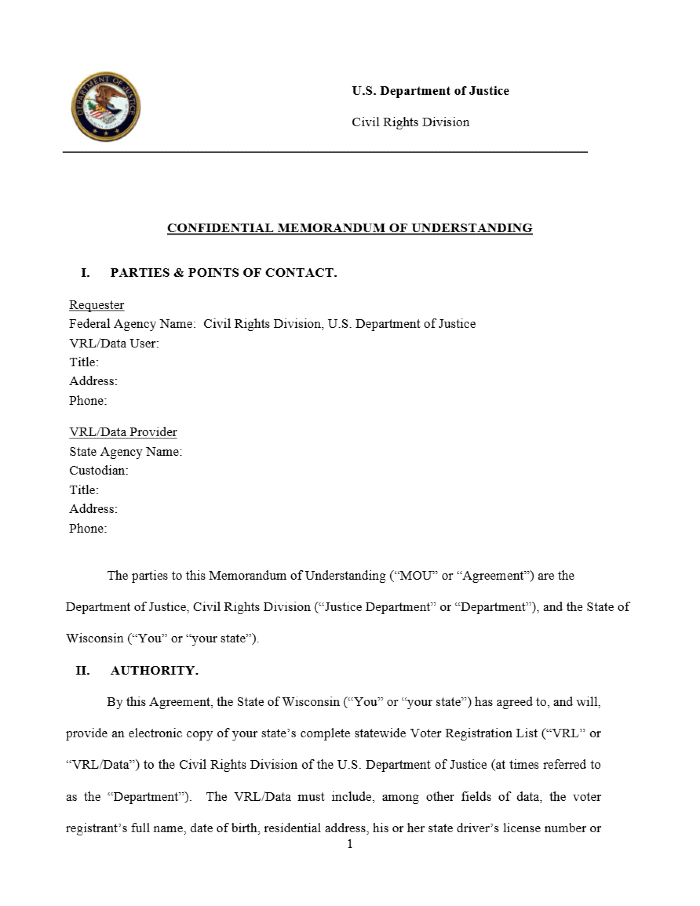
The DOJ wants all states to sign the same agreement, effectively giving the federal government veto power over state voter rolls.
The draft memorandum of understanding, which is labeled “confidential,” outlines the terms of the proposed agreement between each state and the Justice Department. After a state provides its voter roll, the federal department would agree to test, analyze and assess the information. The department would then notify states of “any voter list maintenance issues, insufficiencies, inadequacies, deficiencies, anomalies, or concerns” found.
Each state would agree to “clean” its voter roll within 45 days by removing any ineligible voters, according to the memorandum. States would then resubmit their voter data to the Justice Department for verification.
Given this framework, it is reasonable to ask: How can the public trust that the Trump administration will faithfully identify ineligible voters and not selectively target voters with Hispanic-sounding names, foreign-born parents, or characteristics correlated with opposition to Republicans? Will the voters that the DOJ demands be disenfranchised actually be ineligible to vote, or will they be U.S. citizens purged under false pretenses?
- Further reading: “Why the Myth of Noncitizen Voting Persists,” Brennan Center, “Despite grand claims, a new report shows noncitizen voting hasn't materialized,” NPR, “Unpacking Myths About Noncitizen Voting — How Heritage Foundation’s Own Data Proves It’s Not a Problem,” American Immigration Council