ICE warehouses update: 10 purchased, 10 blocked

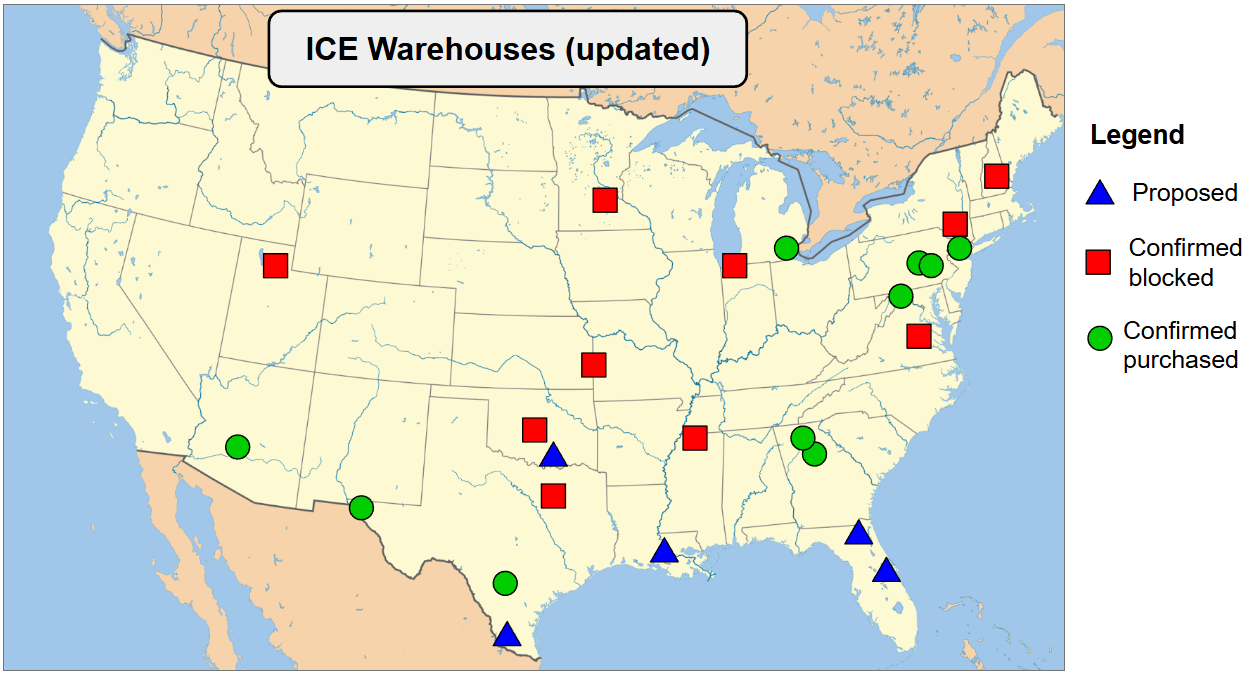
Last month, I posted a list of the 23 known warehouses the Department of Homeland Security was attempting to purchase to convert into concentration camps. Today, I have an update on which warehouses have been purchased and which sales have been blocked or declined.
- To support my work, you can subscribe to the non-paywalled Keep_Track newsletter or contribute via Patreon or Venmo/Paypal.
To date, DHS has bought 10 warehouses, including three additions in Georgia, Michigan, and New Jersey.
Bought by DHS:
- Surprise, AZ: 1,500 bed facility, purchased for $70.4 million ($58.3 million over value)
- Social Circle, GA: 8,500 bed facility, purchased for $129 million (nearly $100 million over value)
- Flowery Branch, GA: 1,500 bed facility, purchased for $68 million ($67.5 million over value)
- Hagerstown, MD: 1,500 bed facility, purchased for $102.4 million ($25.6 million over value)
- Romulus, MI: 500 bed facility, purchased for an unknown amount
- Roxbury, NJ: 1,500 bed facility, purchased for $129.3 million ($74.6 million over value)
- Tremont, PA: 7,500 bed facility, purchased for $119.5 million ($59.8 million over value)
- Hamburg, PA: 1,500 bed facility, purchased for $87.4 million (nearly $30 million over value)
- Socorro, TX: 8,500 bed facility, purchased for $123 million (nearly $112 million over value)
- San Antonio, TX: 1,500 bed facility, purchased for $66.11 million ($28.5 million over value)
10 warehouses on DHS’s original list of prospective facilities are no longer under consideration, in many cases because the owners backed out due to public pressure:
Warehouse sales blocked:
- Merrillville, IN: Owner has declined to sell or lease the building to DHS.
- Shakopee, MN: Owner has declined to sell or lease the building to DHS.
- Kansas City, MO: Owner has declined to sell or lease the building to DHS.
- Byhalia, MS: Republican Sen. Roger Wicker personally appealed to then-DHS Secretary Kristi Noem to abandon plans to purchase the warehouse.
- Merrimack, NH: Republican Gov. Kelly Ayotte personally appealed to then-DHS Secretary Kristi Noem to abandon plans to purchase the warehouse.
- Chester, NY: A state Assembly member said DHS will not be moving forward with the Chester site at this time.”
- Oklahoma City, OK: Owner has declined to sell or lease the building to DHS.
- Hutchins, TX: Owner has declined to sell or lease the building to DHS.
- Ashland, VA: Owner has declined to sell or lease the building to DHS.
- Salt Lake City, UT: Owner has declined to sell or lease the building to DHS.
Three warehouses from the original list, plus two new warehouses, are reportedly under consideration.
Proposed ICE warehouses:
- Orlando, FL: Still under consideration from original list. Located at 8660 Transport Drive, Orlando, FL.
- Starke, FL: A new addition that DHS may purchase located at 14281 US 301, Starke, FL.
- Port Allen, LA: Still under consideration from original list. Located at 2070 Commercial Dr, Port Allen, LA.
- Durant, OK: A new addition that DHS may purchase located at 2306 Enterprise Blvd, Durant, OK.
- McAllen, TX: Still under consideration from original list. Located at 6900 S International Pkwy, McAllen, TX.
WHAT WE KNOW
Despite spending over $890 million in taxpayer money acquiring warehouses, almost nothing is publicly known about how these planned camps will actually operate. The most detailed picture available comes from the local government in Social Circle, Georgia, where officials posted infrastructure and engineering documents produced by ICE. Those documents reveal that DHS intends to implement a "Hub and Spoke Model," in which smaller processing facilities funnel detainees into large "mega-centers" designed to hold people for an average of 60 days. The Social Circle warehouse would serve as one such mega-center, with a capacity of 7,500 to 10,000 people at a time. A partial floor plan released by ICE — though poorly photocopied and difficult to read — shows how the government plans to pack roughly 5,000 people into a series of 80 cells on the first floor alone.
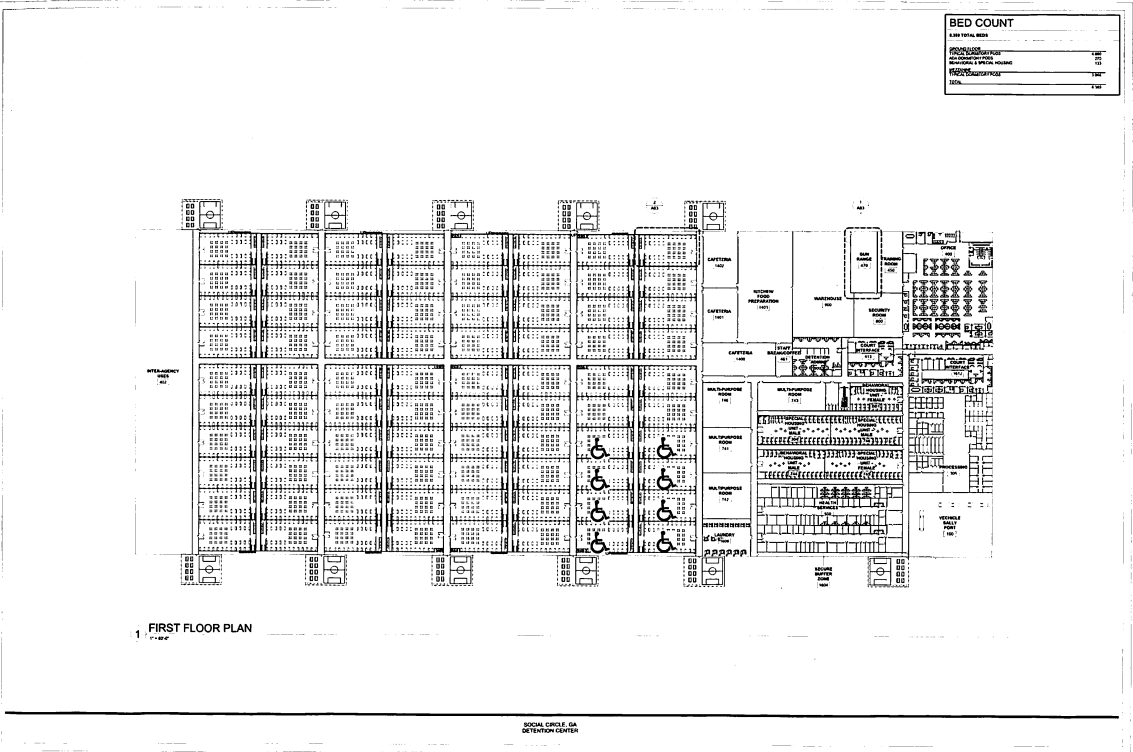
The schematic has drawn comparisons to diagrams of 18th-century ships used to transport enslaved people from Africa to the Americas. The comparison is apt, but we don’t need to go back centuries to understand the implications of storing human beings like livestock or merchandise. People today, imprisoned in America’s largest (current) detention center at Camp East Montana, have submitted sworn declarations describing unsafe, inhumane, and abusive conditions carried out in the name of the American public.
Declaration of “Isaac,” a 43-year-old man from Cuba (warning: description of physical and sexual assault):
On a day approximately September 15-17, 2025, the guards used force against me because they tried to take me to Mexico and I told them I don't want to be taken there. The guards came into my housing unit and told me I was going to be deported. When I asked them where, they told me I will be taken to Mexico. I told them "no," at which point those guards left. However, they came back with about 30 other guards. Outside in the hallway, the guards started beating on me.
The guards hit my head. They slammed it against the wall approximately ten times. Also they squeezed and twisted my ankles. The guards also grabbed and crushed my testicles between their fingers, which was very painful and humiliating. I felt like I was being sexually assaulted. After the guards slammed my head against the wall, I had severe pain behind my ears. I couldn't even touch the left side of my head for about a month because of the pain. The guards seemed to be trying to not leave visible marks on me. Other detained people tried to help me when I was beaten, but one of them was so severely beaten that he ended up in a wheelchair himself.
Declaration of “Eduardo,” a 35-year-old man from Cuba:
The food here is so bad I hardly want to talk about it. It seems to just be getting worse and worse with time. Just seeing it might make a person vomit. I would not even feed the food we are given to the dog at my house. The food is frozen. When it defrosts, it becomes very liquidy. The food makes me feel sick almost every day. My stomach hurts. I often have diarrhea and sometimes vomit. Others in my unit also seem to be suffering with diarrhea and vomiting from the food.
Declaration of “German,” a 33-year-old man from Cuba:
People here don't seem to be getting the medical care they need. For example, there was a man in my unit who seemed to be in his sixties. He had high blood pressure and often complained that he was not feeling well. He kept asking for medical attention, which he did not receive. His condition got so bad that he fainted, fell face down on the floor, and it looked like he broke his nose. He was bleeding profusely because of the fall and broken nose. When we tried to get the guards' attention, they did not come. When the guards finally came to give out our meal, they ignored the man who was still on the ground in a puddle of his own blood. They left the man's meal on his bed.
Declaration of “David,” a 35-year-old-man from Mexico:
At Fort Bliss, I am held in the C-4. In my unit, there are about 72 people. It is dirty and hardly gets cleaned. The bathrooms are especially dirty. The shower drains do not work and constantly cause flooding. The flood water is dirty, filled with urine and fecal matter. The guards are aware of this, and we have repeatedly requested that they fix the flooding problem. No one has attempted to fix the issue. As a result, I have had to ask for cleaning supplies to try [to] keep our unit clean. However, they only let me borrow a broom and a mop. They don't provide soap or cleaning supplies. This makes it difficult to keep our unit clean.